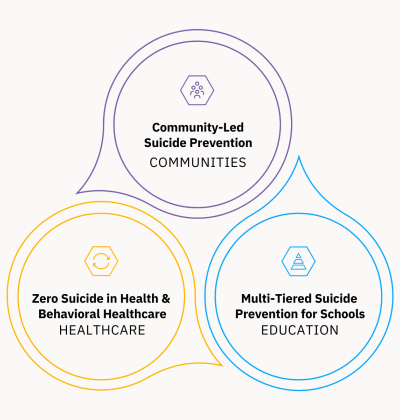
Leveraging decades of leadership in suicide prevention, EDC advances comprehensive frameworks that strengthen alignment across healthcare, education, and community systems to save lives.
Suicide Prevention at EDC
EDC is home to the National Action Alliance for Suicide Prevention, serves as a partner organization for the SAMHSA-funded Suicide Prevention Resource Center (SPRC), and is the training center for Assessing and Managing Suicide Risk (AMSR). Since 1958, EDC has been a trusted partner for federal, state, and local education, healthcare, and community organizations around the globe.
Reach out to our experts at solutions.edc.org to learn more about EDC services and connect with others doing this important work.
EDC's Comprehensive Frameworks
When implemented together, EDC’s suicide prevention frameworks create a cross-sector continuum of care that breaks down silos and strengthens prevention at every level.
- Community-Led Suicide Prevention
Community-Led Suicide Prevention (CLSP) provides an evidence-informed framework to help communities strengthen their implementation of effective suicide prevention. CLSP supports the development of community suicide prevention coalitions focused on widespread and sustainable impact.
Since 2023, EDC has engaged 8 cohorts of over 200 community members representing 44 counties in CLSP trainings and technical assistance.
We offer free resources for community coalitions to get started on our Community-Led Suicide Prevention Toolkit.
- Zero Suicide in Health and Behavioral Healthcare
Zero Suicide is a continuous quality improvement approach to safer suicide care in health and behavioral healthcare systems. With a focus on patient safety, the Zero Suicide framework transforms systems using evidence-based practices.
Since 2015, Zero Suicide at EDC has trained over 5200 individuals representing more than 1200 organizations at our Zero Suicide Academies.
EDC's Zero Suicide Toolkit offers free implementation resources for health and behavioral healthcare organizations.
- Multi-Tiered Suicide Prevention for School
Multi-Tiered Suicide Prevention for Schools (MTSP) guides K12 schools in implementing systemwide approaches to suicide prevention that align with Multi-Tiered Systems of Support. MTSP champions the development of school teams dedicated to creating environments that protect against student suicide.
Since 2022, EDC has engaged 5 cohorts of over 375 school community members representing 35 school districts in the MTSP implementation process.
The MTSP Environmental Assessment is a free companion tool that guides school leaders in evaluating their current suicide prevention efforts across all levels of support.
Frequently Asked Questions (FAQs)
- How Do EDC’s Frameworks and Services Support One Another?
CLSP provides a framework that guides local communities in bringing partners across different sectors and settings together for collective action in suicide prevention. CLSP provides an umbrella that encompasses all other setting-specific work in suicide prevention, ensuring efforts across sectors are effectively aligned and coordinated.
MTSP and Zero Suicide provide guidance to health and mental health providers serving K12 students on best practices in suicide-care. MTSP provides unique recommendations, technical assistance, and resources to support healthcare systems in effectively applying Zero Suicide principles in schools. School districts investing in system-wide suicide prevention can collaborate with mental health providers to align suicide-care practices with those called for in the Zero Suicide Toolkit.
- What Do All Three Frameworks Have in Common?
- EDC’s suicide prevention services focus on implementing evidence-based strategies in prevention, intervention and postvention, as well as the development of policies and protocols to support fidelity and quality in suicide care.
- Our expert staff guide teams through assessment of current practices, action planning for improvement, and sustainability efforts.
- Implementation is led by a multi-disciplinary team that includes collaborative community partnerships and individuals with suicide-centered lived experience.
- Why Invest in All Three Frameworks and Services?
Suicide remains a complex issue with multiple causes that interplay across the groups where we live, work, and play. EDC’s suicide prevention frameworks provide targeted sector-specific information while also offering shared language, concepts, and practices that enable a comprehensive approach to suicide prevention. By applying EDC’s collective suicide prevention frameworks in your communities, partners will be better able to create shared ownership of their unique connected roles in suicide prevention.
- Does EDC Offer Suicide Prevention Trainings for Clinical and Direct Care Staff?
AMSR
Our Assessing and Managing Suicide Risk (AMSR) training helps health and behavioral health professionals feel confident providing compassionate care to people at risk for suicide.
Since 2006, our AMSR authorized trainers have trained over 119,000 participants in hundreds of public and private organizations, colleges and universities, and branches of the U.S. military.
AMSR trainings for Inpatient, Outpatient, and Substance Use Disorder settings prepare healthcare professionals to understand and respond to suicide risk. Designed for clinicians who conduct suicide risk assessments, we also offer companion AMSR Direct Care trainings for other care team members who need to understand risk formulation and treatment planning. Trainings are available in person and online with a facilitator, and as on-demand courses.
CALM
Counseling on Access to Lethal Means (CALM) is a free, self-paced, award-winning online course for healthcare and social services providers. Reducing access to lethal means, such as firearms and medication, can determine whether a person at risk for suicide lives or dies. This course is about how to reduce access to the methods people use to kill themselves. It covers who needs lethal means counseling and how to work with people at risk for suicide—and their families—to reduce access.
Collaborative Safety Planning
EDC's training in Collaborative Safety Planning introduces and expands two core, research-based interventions: the Stanley Brown Safety Plan and EDC’s Counseling on Access to Lethal Means (CALM). Together, these strategies provide a concrete framework for any healthcare, education, or community professional to build rapport with individuals and their support persons to implement safety-focused interventions that can reduce suicide attempts and save lives.